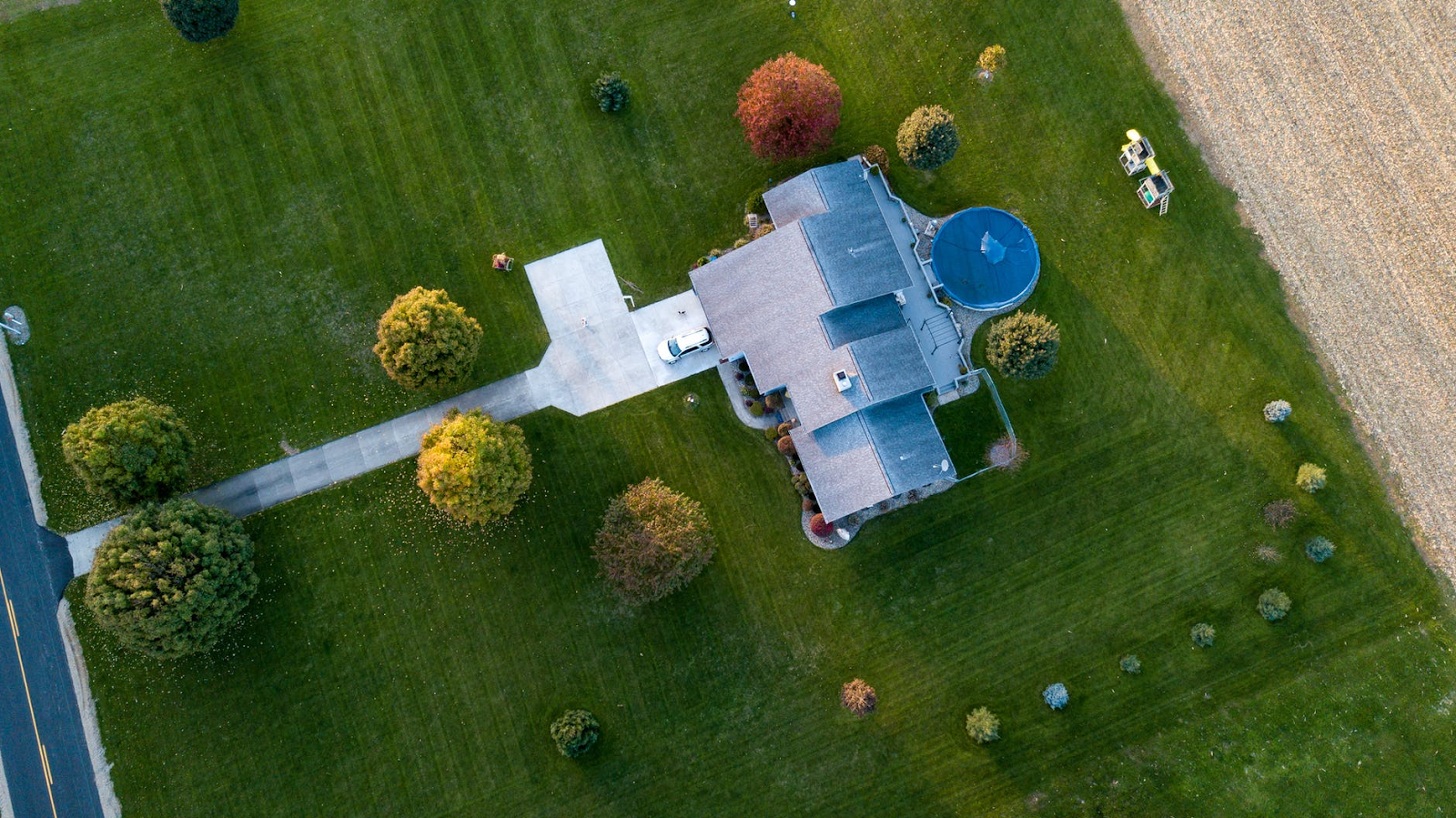
While most of your lawn is probably in direct sunlight for most of the day, there will be patches that remain in the shade, especially as the seasons change.
In the winter, for instance, the sun doesn’t rise high in the sky. This pattern creates long shadows for several months, leading grass in some parts of your lawn to be deprived of the light it needs to thrive.
Often, there’s nothing you can do to remove the source of the shadows, either. It could be your two-story house or a large, protected tree (or something on your neighbor’s property). Thus, your only option is to adopt proper lawn care. But what does that involve when parts of the lawn experience a lot of shade? Here’s some advice.
Keep The Lawn Hydrated
The first step is to keep the lawn hydrated, especially in the summer months. If grass doesn’t have sufficient water, it will brown more quickly.
Choose Shade-Loving Species Of Grass
Next, you’ll need to be selective of the grass species you choose. While most varieties need around six hours of sunlight per day to bounce back in the spring, some species can survive low-light conditions for extended periods.
Savvy gardeners, therefore, vary grass species across their lawns according to expected light levels. If they know a particular corner will struggle to get the sunshine it needs to thrive, they sow more robust seeds here.
This strategy is one that many stately homes use to keep their lawns looking fresh and verdant year-round. They’ll vary the species they plant according to the expected conditions. If light levels are going to be low, then they will scatter more seeds of grass species that can survive them.
Hire Professional Help
Have you ever been to a friend’s house and marveled at how they managed to get a perfect lawn? Well, usually, the state of their grass has nothing to do with their personal efforts. Instead, they’ve usually hired professional help.
Affordable lawn care might be the right option for you if you’re a busy person who doesn’t have enough time to spend in the garden, tending to your lawn. Professionals put your grass on a schedule, feeding and watering it periodically according to the prevailing weather conditions and climate.
Make Weed Removal A Priority
The combination of shade and weeds will immediately kill patches of grass, trying to survive in low light conditions. Invasive plant species steal resources from the grass, causing it to die back. Be sure that you operate a robust weeding schedule to remove unwanted plants the moment that they appear in vulnerable spots on your lawn.
Grass near borders tends to receive more shade than grass in the middle of your lawn. Furthermore, it has to compete with neighboring plants for resources. Therefore, professional gardeners suggest that you find ways to increase the gap between the plants in your borders and the grass. The more significant the distance, the less likely the grass will die.
I squeaked by in high school chemistry doing little more than fiddling around with the Bunsen burner so it would throw flames like a tiny oil refinery. I was easily distracted in class, but I never saw any reason to dispute the science behind the periodic table.
What little do I know now?
Chemistry was hard to grasp.
Addressing the alarming consequences of climate change is harder.
Too hard for the President.
Numbing out is easier.
Late May
Bless a few of my Trump-loving friends who have turned a corner and, now, at least, acknowledge that POTUS is crazy, but insist: “If your plumber can fix a leak, who cares if he’s crazy?”
I care.
Also he’s not fixing the leak.
Our crazy President gaslights science as counterfeit and remains unbudgeable on climate change.
This is scary.
Mid-July
Our two-acre melting pot of native pollinators is inconsequential in any larger environmental sense, but I feel healthier and happier walking through a diverse meadow of colors, scents and hummingbirds.
Is this an illusion—the doping effect of a do-gooder?
Late August
Goldenrod, ironweed, green milkweed and frostweed have crossed into our meadow. That’s OK. They join big bluestem, greasy grass, prairie coneflower, New England Aster and other native species that were originally sown late in 2011.
Wind has blown in box elder seeds, and squirrels have buried walnuts. The meadow seems stubbornly determined to return to the central Kentucky forest it once was.
Mid-September
Our meadow won’t save the earth.
The planet can only be preserved with personal, and powerful, worldwide leadership.
Let me introduce a national park you’ve never heard of – the Greenbelt National Park, 1,200 acres of woods, trails and campsites just 10 miles outside of DC. It’s even near a subway station, so no wonder it’s popular with visitors to the area, domestic and international. City residents sometimes camp here, too, enjoying an easy get-away in nature.
The park is less than a mile from my house, so I’ve visited many times and written about its volunteers, its events and its superintendent.
Retirees serving as campground hosts for a 3-month stint.
So imagine my surprise when I heard that the park is one of four possible locations for Trump’s “National Garden of American Heroes,” announced by Executive Order on July 3.
That’s a few scandals ago, but remember when the removal of Confederate statues was in the news? This “garden” idea was one of Trump’s least offensive reactions to all that, to just pick his own “heroes” and put up statues for them. The announcement said that preference would be given to “the Founding Fathers, former Presidents of the United States, leading abolitionists, and individuals involved in the discovery of America.”
The first 31 “heroes” are: Billy Graham, Antonin Scalia, Ronald Reagan, John Adams, Susan B. Anthony, Daniel Boone, Davy Crockett, Amelia Earhart, Alexander Hamilton, Abraham Lincoln, Douglas MacArthur, Christa McAuliffe, George Patton, Betsy Ross, George Washington, Wilbur Wright, Orville Wright. Joshua Lawrence Chamberlain, Henry Clay, Benjamin Franklin, Thomas Jefferson, Dolley Madison, James Madison, Audie Murphy, Harriet Beecher Stowe, Clara Barton, Booker T. Washington, Frederick Douglass, Harriet Tubman, Martin Luther King Jr., and Jackie Robinson.
The list was described as not exhaustive, and our mayor was told that the number of statues could rise to several hundred!
Statues of Ronald Reagan and Antonin Scalia, and statue of Billy Graham being removed from downtown Nashville.
Not just the names but the sculptures’ style would be dictated, too. “All statues in the National Garden should be lifelike or realistic representations of the persons they depict, not abstract or modernist representations.” Because no Modernism! (This is consistent with Trump’s draft Executive Order – called “Making Federal Buildings Beautiful Again” – requiring that all new federal buildings be Classical in style.)
Now in my first career I attended dozens, maybe hundreds of meetings about proposed memorials and statues in DC, so I’d read the “Garden of Heroes” announcement with interest but shrugged it off in the “never gonna happen” category, knowing it takes years for these things to be approved, and Trump would be gone soon, anyway. As one tells oneself these days.
Even if he won re-election (I know, I’m shuddering as I type those words), this would surely go the way of that other expensive vanity project of his – the Wall.
But then shit got real when I got the email from our mayor: “It has come to my attention that one of the locations that the Department [of Interior] is most strongly considering is Greenbelt Park.” He announced a town hall on the subject, which I attended, of course (virtually, like everyone).
Issues Raised in our Town Hall
Legal
The mayor noted the park was commissioned for its “greenery,” which is especially important for a town famous for the green belt around it – it’s “part of our brand!” And when he heard there may be hundreds of statues he wondered, “Are they going to be miniatures?”
So he declared the proposal “legally suspect” and said he assumed it could be tied up in courts, “certainly until January, when things will work out.” (More cautious optimism.)
Political
“The list is horrible! Really insulting.” “It’s a show of force, and very worrisome.” Seems like they’re “sticking it to the liberals.”
“Why not include FDR?” (whose administration created Greenbelt). And it’s “odd to have Scalia without Marshall or Warren.”
Many expressed concern that it would be “very politicized” – no shit!
“Feels like a whim.” “He’s claiming grandeur for himself.” Ditto.
“People will be up in arms about this!”
Someone mentioned the environmental impact statement taking a long time to prepare, and “hopefully Trump would be in jail by then.”
Practical Implications
Is there the infrastructure for all the new traffic?
“Who would be attracted to it?” was a concern that hadn’t even occurred to me but yes, I can imagine people coming here to show their support for the Confederacy. Think Charlottesville. “This feels like infiltration and is very threatening, honestly.”
“It’s a misappropriation of resources.”
The mayor mentioned that lots of cities are actually asking for this! So why not let some other city reap the imagined economic benefits from such a “garden.”
Having solicited input without comment until the very end, the mayor finally declared that “I stand strongly against this project.”
Politics aside, I bet most would agree that putting dozens or hundreds of statues in a forested national park isn’t exactly showing them off to their advantage. To say the least.
About Style
Now I’m pretty inclusive in my artist tastes and would hate to see modernist or abstract works banned. However, I wonder if such a ban would have blocked my least favorite new statue in DC – this one of Martin Luther King Jr. as a Chinese emperor, so tall that visitors rush up to it, only to get a view of his knees.
A favorite of mine is this statue of Frederick Douglass, installed at the University of Maryland campus in 2015. It’s realistic and downright fiery! And at 7.5 feet tall, it’s majestic but still reachable.
I knew full well what I was getting into. My dormant gardening genes from my father’s side kicked in back in 1987, soon after my wife and I bought our first house. I had grown up around gardens. My Dad had a rock garden in the backyard and also a vegetable plot in a nearby community garden. I loved working in that veggie garden until I reached an age where sex, drugs, and rock and roll became a distraction. But I did have that early exposure to both vegetable and ornamental gardening as a kid, and when I got that first piece of ground and those genes reared their ugly heads, for some reason I focused on food. Later on, at our second house, it turned to all things ornamental.
My Great Grandfather in his vegetable patch.
That first vegetable garden quickly became all-consuming. It started large and then got larger. Began with a few tomatoes and peppers. In three or four years, we grew every vegetable, had a small orchard, grapes, and raised rabbits. We were tapping our maples and making wine. The joke is that things got so out of control that we had to move. And so we did. To a house we had long admired only a tenth a mile up the street.
Young, dumb, urban farmers. Circa 1987. So sweet. So innocent.
Although I had every intention of starting a new, albeit scaled down, veggie garden at the new house, it never happened for a variety of reasons. The main reason was that the space I had set aside for the veggie garden we later learned had been at one time a gravel driveway. Compacted beyond belief. Almost like concrete. So it became my propagation area/mini nursery until June 2019, when we wound up hosting my son’s wedding in our back yard. The listing, rusting frame of my hoop house was deemed a poor backdrop for such an esteemed event, and so it went to the scrapyard. In its place, finally, went some raised beds, a grape arbor, and some veggies. Last year, I dabbled a bit. This year I dug in deeper.
The new house, which was in fact way older than the old house. A Dutch colonial whose ground lured me into ornamental gardening. The old nursery before it was removed. In the background is my neighbor’s backyard.
Again, I reiterate, I knew full well what I was getting into. I have always enjoyed irony, and my favorite ironic moment in the world is when, having learned that I work in Horticulture, someone says, “Hey, I’m thinking of getting into gardening, but nothing hard. Just some vegetables. Maybe a fruit tree. Possibly some roses. Got any tips?” “Yeah, think again!”
So, yes, I knew a return to vegetable gardening would have its ups and downs. I expected some disappointments. Still, two things wound up catching me by surprise. First, was just how emotionally invested I became in this new part of the garden, and, second, just how total was my failure! I tried denying much of it for a while, but then my humiliation was complete when I recently had cause to visit a nearby community garden. There, in plain sight, I could compare the overflowing bountiful harvests being enjoyed by some twenty or thirty area residents, all of them mere amateurs, as the image of my own barren wasteland periodically appeared in my head. As we walked about, I posed as respectable horticulturist and did not mention anything about my troubles and doubts to the woman who was showing me around.
The barren wasteland. A field where dreams go to die but where shame and humiliation flourish.
In my defense, my garden is prettier than any that I saw there, and we did harvest some lettuce, beans, and garlic. And my tomato plants are beautiful. Ten feet tall, they are tied up to a bamboo frame in a straight row. They even screen the view of my neighbor’s yard from where we sit on the patio. It’s just a damned pity that the neighborhood cartel of squirrels got it in their stupid, disturbed little squirrel brains to cut off and partially eat my entire crop of beautifully developing green tomatoes.
And then there was a deer. I never have deer in my backyard. We have a four foot fence which is heavily planted on both sides with all kinds of trees and shrubs, so, having no place from which to launch and nowhere to land, they never visit. Until one day this summer. Like a bonehead, I removed one little extra shrub to make more light for my veggies. Never even occurred to me that I had just created a hole in the defenses. Two nights later, the world’s most observant deer, but also a very clumsy one, found the breach, got in, and busted off the one tomato plant whose loss could embarrass me.
At a master gardener’s conference 2-3 years ago, I met another speaker whose name is Heather Pariso. She wound up offering to send seeds of a tomato that she had bred herself for me to grow at the Cincinnati Zoo & Botanical Garden. But then I lost the seeds, and then suffered shame when Heather checked in to see how they were doing. But then I found the seeds, and started them over winter in my basement at home. Sent Heather a happy email telling her so. I thought I would plant them at the Zoo, but then COVID-19 hit. Because I was working from home, I wound up planting one plant in my garden. How could I know then that spot where I put it would soon be the very place where a klutzy deer would stumble around like a belligerent drunk? Of course Heather texted a month later to see how the plant was doing, and, once again, I suffered shame.
Me, more recently, receiving adoration from the master gardeners who attended the conference where I met Heather.
We’ve all known that person who brings in hundreds of pounds of zucchini and begs everyone to take some? Well, that sure wasn’t me. My squash plants grew beautifully, put out hundreds of flowers. Know how many squash we enjoyed? Exactly one. That’s all that developed from all those flowers. WTH?
Does all this failure, humiliation, and shame mean I’m going to quit? Absolutely not. I’m nowhere near that smart, and I’m already making plans for next year. I might need more light, so I’m thinking of cutting down the gingko. Or the coffeetree. Maybe both. Maybe I need a truckload of manure. Maybe I need to buy a gun, learn how to hunt, and develop a taste for squirrel. I’ve got ideas. I can go all kinds of directions, but I can’t go back on the vegetable garden. Not now. It’s on, and I’m all in.
The latest of the Virtual Summer Garden Tours we’re assembling instead of holding in-person tours is the cool oasis created by the talented gardener Sandra Lange.
Luckily for us, Sandra’s son David Barnes is a professional videographer and was available to work with her to create a PBS-quality tour, with Sandra providing the narration. It’s embedded below. But first, an introduction.
About the Gardener
Sandra did not have a garden until she moved to Greenbelt in 1966 when she discovered her love for the natural world and her proximity to Behnke’s Nursery. Over the years, she visited many gardens, including several in Japan and China. She attended flower shows—Floriade in the Netherlands, Chelsea in London and, of course, Philadelphia.
Over the past 50 years, she and her gardening buddy, Mary Lou Williamson, toured many gardens and nurseries throughout Washington, Virginia and Delaware, and shopped plant sales near and far. Inspiration for her own garden has been influenced by her travels, gardening publications and programs, as well as by meeting many dedicated gardeners.
About the Garden
The primary focus of Sandra’s garden is her pond. She and her husband David moved into their present home in 2003. In 2005, they engaged Meadows Farms to design a free-form, irregularly shaped 12′ x 18′ pond with two waterfalls that cascade into stream beds that flow into the main pond. Weathered limestone rocks of various sizes and shapes surround the pond. There also is an 11 x 17 foot shaded flagstone patio and walkways.
Sandra planted a variety of trees and shrubs—Zelkova, Japanese maples, Chinese fringe tree, Heptacodium (Seven Son), Chaste trees, Japanese willow, viburnums, oak leaf hydrangeas, camillias, all of which have matured over the past 15 years. She has a collection of peonies, including four Itohs, an edgeworthia (paper bush), varigated deutzia. There are many varieties of ferns, astilbe, azaleas, hostas. A Japanese style arbor frames the entrance to the garden. A collection of pots feature banana plants, amorphophalllus lillies (corpse flower), pineapple lilies, hibiscus.
The pond is host to burgundy colocasias, deep red irises, acorus, ginger and lotus plants, three koi, frogs and an occasional black snake.
The lawn was eliminated several years ago and replanted with Japanese ferns, variegated liriope, brunnera and epimedium. The entire yard is surrounded by white and red oaks and hollies that transport one into a lush and peaceful environment.
Rant reader Dale Leeper posted the comment about his home-made bird bath in a comment to my bird bath story, and it sounded great to me. I emailed right away asking for photos, and here they are!
Watching the video, it is apparent the bird is afraid of falling into too deep water. Unfortunately, bird baths are often made with human aesthetics in mind instead of the bird’s need. The sides are steep and slippery.
I made my birdbath from a terracotta 16-inch pot saucer. The edges are thick and provide good gripping. The bottom is flat and only a little over an inch deep. Birds have little fear of it.
I placed it on a pedestal I made from an old tree stump cut to about 3 to 4 feet. First I placed an inch of sand on the ground, tamped it down, and leveled it. On top of that a $1, 16-inch cement stepping stone from the home store. The stump sits on top of that, keeping it off the soil.
Then I put 3 galvanized screws in the top of the stump about 8 inches apart in a triangle. The screws can be screwed up or down to make them level with each other using a bubble level. Place the pot saucer on that and fill with water that will be level.
It’s easy to clean since the saucer just sits on the screws and the terracotta is heavy enough to keep it in place even if a squirrel visits.
I’ve had it for at least 10 years and the stump has not deteriorated yet.
It looks natural in the landscape, too.
The screws are raised or lowered to keep the saucer flat.
Through our ongoing letters and because of the few times we’ve hung out, I must admit I have become rather fond of you. Despite having a few lingering concerns caused mainly by your fixation on all things British, I pretty much consider you a friend. Yet, I was surprised by how angry I got when I read in your letter about the woman (who will be from now on referred to as “Clueless Lady Critic”) who had reacted to a recent post on your website by stating that she was, “Looking for something more positive.” In an earlier draft I wrote something here my wife made me remove, but let’s just agree that that was an incredibly rude and ignorant thing to say!
One of the things we have in common is whatever that mental disease is that causes someone to garden too much. People like us always want to do more, and have just enough drive to almost get it all done. The void, of course, causes stress, which is relieved, of course, by one of two spirits and tonic water. On one hand, this is okay. This, along with our unwavering commitment to journalistic integrity, is what gives us such cred with our loyal readers, who are, each and every of them, elite gardeners and amazing people. They appreciate our honest and heartfelt attempts to find and express absolute gardening truth. Yet, on the other hand, it sets us up to periodically crash and burn, which, sure as hell, happens every August.
Spring is a breeze. Lots of work, but it feels good. Like it’s making a difference. Like it’s setting you up for a beautiful summer. You feel creative and in control.
So if “Clueless Lady Critic” was expecting to read airhead happy, peppy, dopey, dumb as hell garden writing that came from anywhere other than the UK or PNW in August, then what she really wants is to be lied to. Obviously lied to. Like from a millionaire African Prince who loves her madly and needs only a small loan to unlock his tremendous wealth so they can live happily ever after. For some reason, I picture this woman at home in a big fancy house. She is, of course, inside, air-conditioned, hydrated, drinking wine in the afternoon, and unsuccessfully trying to amuse herself by micromanaging her gardener by text, writing vicious, hateful remarks in the comments section of online news articles, and, when the opportunity arises, ripping the heart out of a fragile, honest, earnest, and truthful garden writer. A garden writer who lives in Virginia of all places, and whose one mistake was posting something she wrote in August. By the way, I totally apologize if this description of “Clueless Critic Lady” critic in any way resembles how you might have looked as you composed your recent rant on Martha Stewart earlier this week. If that is so, it was purely an unfortunate coincidence.
Until mid-July, everywhere you turn is exuberance. Color. Life. Growth.
Marianne, I don’t know your opinion, but 2020 has been a big disappointment to me. This, of course, only made August worse than it usually is. I started at least five blogs and articles which experienced absolutely no quality of life at until they began an extended period of suffering before, mercifully, I killed them. They all started with good ideas, I thought, but it was impossible to find one redeeming thing about any of them. The more I tried, the worse they got. Even now, midway through September, I’m still feeling the effects. This letter had multiple false starts. It has taken almost two weeks, and I still don’t like it. But, I now know that it served a very useful purpose. Only by writing this was I finally able to see that these struggles had nothing to do with my limitations as a writer. They were entirely caused by August’s endless capacity to crush one’s spirit. And although it was mortifying to miss my August Garden Rant deadline, I’m glad that I did. If I had posted anything more than a grocery list (which even on its fifth draft would have been cliche-ridden and full of mistakes), our loyal readers, each of them elite gardeners and amazing people, would have seen right through it. Every effort at humor? Flat as Kansas. The hope for some fragment of insight? A false hope. And anything that feigned that I still cared about anyone or anything at all would have been an obvious lie. Our loyal readers would have revolted! I would have looked like a complete fraud, and I’d really prefer to keep everyone guessing about that for as long as possible!
The issue here is the divide between readers who know about trying to garden in August and those who don’t. Over 90F days all over the place. Humidity. Lots of work to do, but none of it is the fun, creative stuff you do in spring or fall. Nope. It’s just hard labor. Tasks like dragging hoses around and defibrillating your spouse who unwisely offered to help out. And, although the garden is still functioning, the reward is greatly diminished. It pretty much looks as bad and tired as you do.
Then there’s August.
What we really need is for a celebrity gardener to inform the general public about what to expect from honest garden writers in August. Someone willing to scream it in profanity-laced streams of invective at Master Gardener conferences. Martha Stewart would have been the obvious choice, but I think you might have nipped that one in the bud with your hatchet job on her a few days ago. Maybe we can get P. Allen Smith to record a public service announcement that might sometimes run on PBS between 2:00 and 4:00 AM. “P. Allen Smith here, telling y’all to skip your chores in August, and remember to go a little easy on our garden writing friends.” Might help.
I’ll see what I can do. I know a guy from Arkansas. They’re probably related or something. In the meantime, I need to get rolling. August has left me with a backlog of life to get caught up on. I suppose I’d better try to get some of it off my plate. I’ll be following with another note soon about my adventures trying to grow a vegetable garden this summer. Another reason my will to live needs resuscitation.
The Heart of Darkness exploring the vegetable garden in spring. We give him a home. We feed him. But will he chase off squirrels? Turns out, no.
By the way, I’m having further doubts abut your friend Beth Chatto. If you’re already gardening in the hottest, driest part of England, is it such a great idea to put a gravel garden on top of a parking lot? I think it would have been smarter to find a better spot, amend it with organic matter, and maybe install irrigation. But, hey, what do I know? That’s just me.
Your Friend,
Scott
PS-I may be rather fond of you, but I fell over the top in love with your wickedly smart and sharply efficient response to “Clueless Critic Lady’s” snarky comment and notification that she would be blocking your posts. If I should live long enough and type enough random letters to ever string together six words as brilliant as, “relieved me of her reading services,” it will be over. From that moment on, I will be impossible to live with!